Navigating the Open Water
A Real-Talk Field Guide for Your 20s
A Real-Talk Field Guide for Your 20s
Welcome to the Middle of the Ocean
If you are between 19 and 25 right now, nobody needs to tell you how loud the world is. This is an honest mentor's guide to the next few years — no hype, no five-year fantasy.
You are probably juggling college assignments, entry-level job applications, LinkedIn feeds full of people bragging about their achievements, and late-night doom-scrolling. Everyone tells you to “find your passion”, while your bank account demands that you pay rent.
Here is the truth: most young adults aren't failing — they are simply treading water. You consume endless tutorials, switch topics every three days, and worry constantly about whether to chase safety or take a wild gamble. That constant motion keeps your head above the surface, but it burns all your energy while leaving you trapped in the exact same spot.
“Treading water is still swimming. It just never takes you anywhere.”
— Vedhagiri Damodaran
This short book is written as an honest mentor's guide. It draws from real engineering trenches, boardroom failures, and startup turnarounds to give you a clear map for the next few years of your life.
Stop Treading Water
The Strategic Swimming Framework. Imagine yourself in the open sea. When people start their adult careers, they almost always fall into one of three swimming styles.
How are you currently swimming?
| Style | Daily reality | The inevitable result |
|---|---|---|
| 1. Treading Water (Peddling) | Binging YouTube guides, switching career tracks daily, paralysed by choices. | Exhaustion & burnout: you burn all your fuel without moving. |
| 2. Blind Swimming | Chasing whatever tech skill an influencer hyped up, with zero personal spark. | Lost at sea: you follow the herd into a hyper-crowded race. |
| 3. Strategic Swimming | Pairing what keeps you awake at midnight with a skill the world pays real money for. | Reaching the shore: financial autonomy and long-term momentum. |
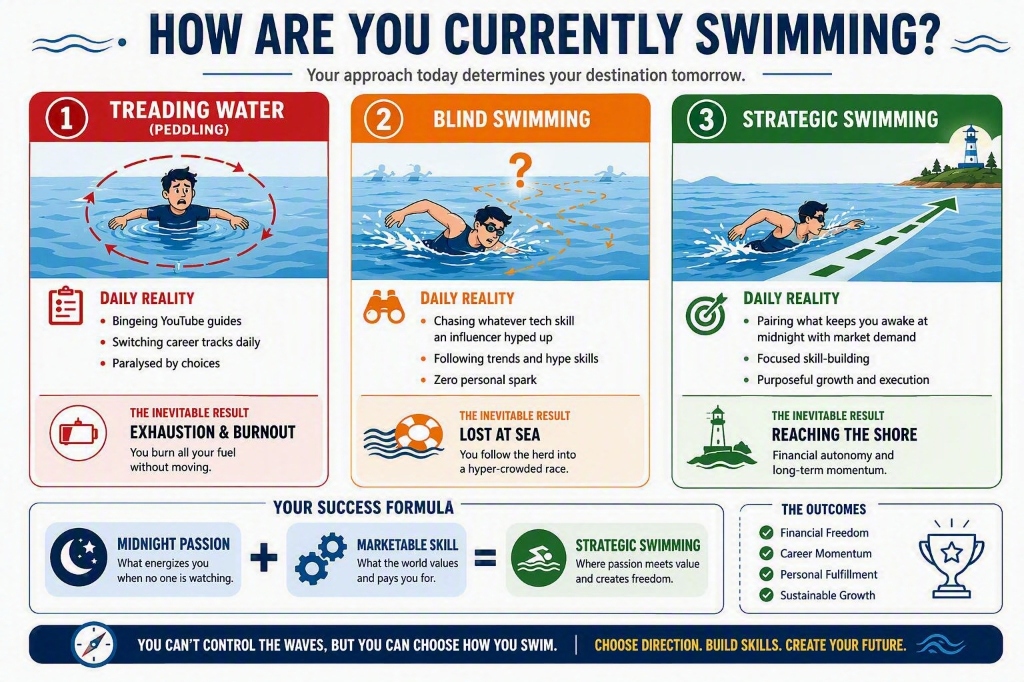
Energy spent against distance covered
The dark bar is energy burned. The brass line is actual distance covered. Treading water is the most expensive way to stay exactly where you are.
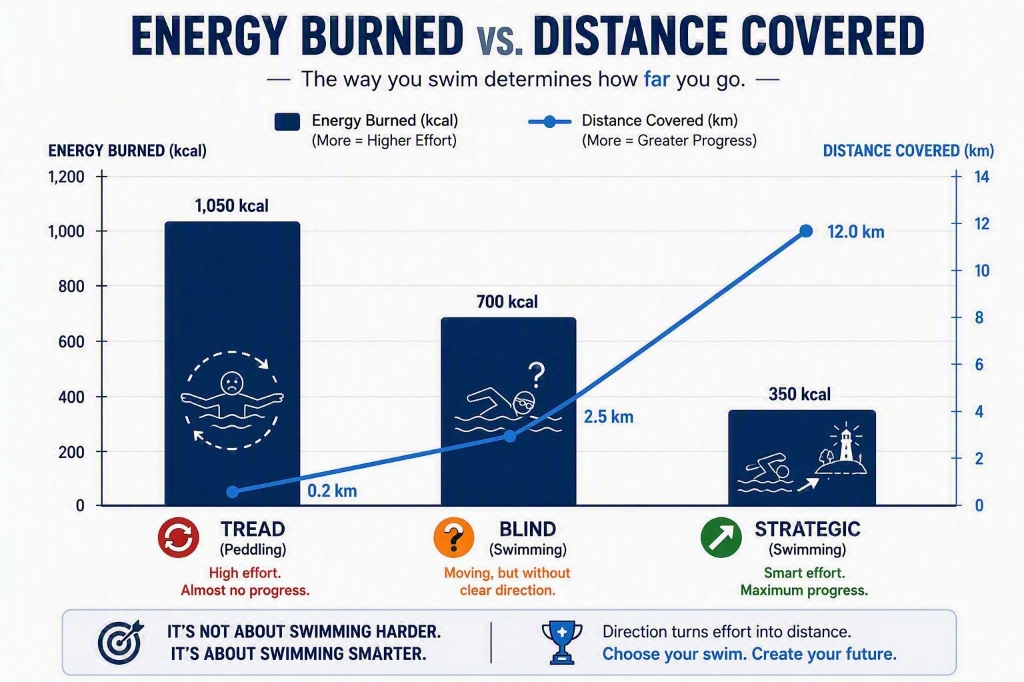
To reach solid ground, you cannot act like a sheep following the crowd, nor can you pretend economic reality doesn't exist. You need a dual-track engine.
The Strategic Swimming Framework
- •What you do for free
- •Curiosity-driven
- •Energy generator
- •What the world demands
- •Skill-driven
- •Economic engine
Track 1 — The Midnight Passion (your energy generator): this is what you explore when no one is watching, when curiosity takes the wheel and money isn't on the line. Track 2 — The Survival Engine (your economic lifejacket): the market does not pay for vague curiosity; it pays for solved problems. You must anchor your curiosity to a high-demand, technical skill.
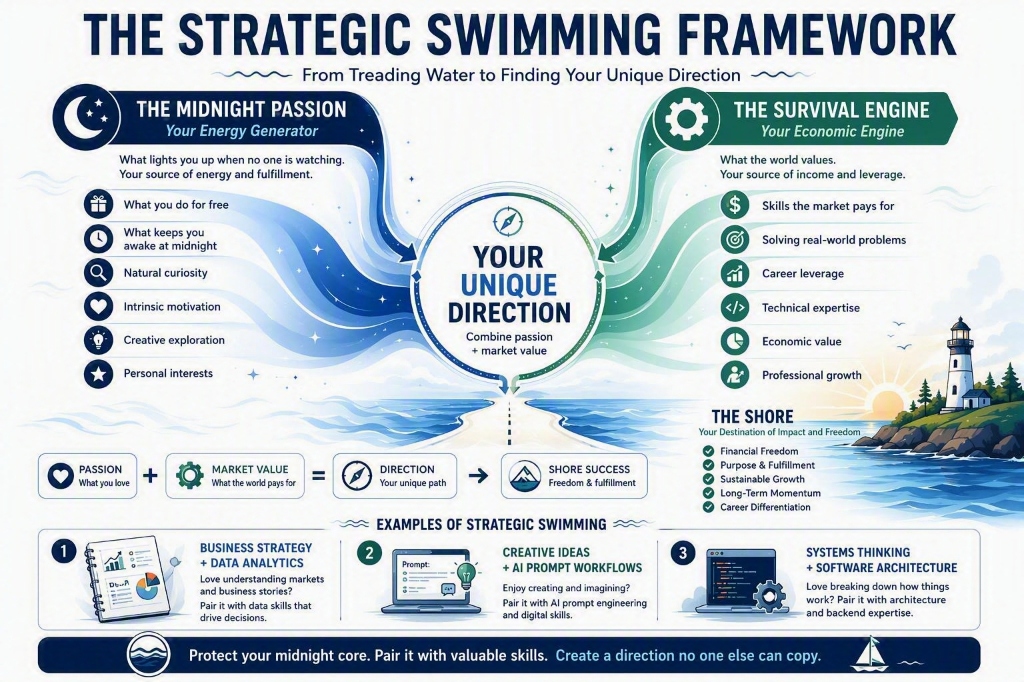
Pairing curiosity with a market skill
Pair with data analytics or performance marketing.
Anchor to AI prompt workflows or technical writing.
Build toward software analysis or backend architecture.
Curiosity alone does not pay. Attach it to a solved problem.
Repeat it a thousand times so you never become a corporate clone.
The Midnight Passion Audit
To discover what actually fuels you today, put aside what your parents or teachers told you to like. Look at your honest habits.
Step 1 — examine your late-night rabbit holes. When you are on your laptop late at night, look past the topic itself and identify the action you are taking.
What your rabbit hole is telling you
| What you do late at night | What actually drives you |
|---|---|
| Reading about how an underdog business grew | Strategy and storytelling |
| Playing with prompts and generating new media | Creation and ideation |
| Dissecting how an application operates under the hood | Systems and analytics |
Step 2 — the two diagnostic questions. The Immersion Test: what is the one task where you completely forget to check your phone or notice the clock? The Freedom Test: if your living expenses were 100% paid for the next 12 months, what would you spend tomorrow morning experimenting with purely for the thrill of discovery?
“That is your compass anchor.”
— Vedhagiri Damodaran
Carving Your Own Path
D.E.A.R. When you enter tech or business in your early 20s, the easiest mistake is copying whatever is trending. But imitation leads to hollow burnout.
Real breakthroughs come from building authentic, differentiated value. Leading software platforms don't win by copying bells and whistles; they anchor themselves strictly on core utility, customer obsession, and rapid feedback loops. The best teams give builders autonomy to execute on their strengths rather than micro-managing them into compliance.
The D.E.A.R. code for young builders
| Pillar | What it means for you at 20 |
|---|---|
| Differentiation | Focus on what makes your skillset distinct instead of copying the loudest resume in the room. |
| Empowerment | Lean into what you are naturally good at rather than forcing yourself into a mould you despise. |
| Authenticity | Build work grounded in your principles, not the temporary hysteria of social media trends. |
| Resilience | Stay the course through early errors and messy iterations. |
“Launch, test, and improve. Waiting for complete perfection before showing your work kills your momentum before you even begin.”
— Vedhagiri Damodaran
Flip the Coin
The superpower of perspective. In your 20s, ego and defensiveness are easy traps. You feel you have something to prove.
Picture holding a coin in your palm. On your side rests your personal truth, your background, and your assumptions. On the other side rests the experience and perspective of someone else — a customer, a co-worker, or a manager.
Flip the coin
- •Your background
- •Your bias
- •Your personal assumptions
- •Their background
- •Their pressures and needs
- •Their worldview
Three habits that flip the coin
Give people breathing space to explain without your mind loading a counter-argument.
Spend time with minds that challenge your assumptions; it sharpens your thinking.
Ask: am I looking at this clearly, or running on a preconceived assumption?
Technical Chops, Emotional Intelligence
Whether you study computer science, business, design, or healthcare, technical skill is only half the equation.
The individuals who rise, build lasting companies, and keep their sanity are the ones who master Emotional Intelligence.
The five faces of emotional intelligence
| Capability | What it looks like in practice |
|---|---|
| Self-awareness | Acknowledging stress, knowing your emotional triggers, and treating yourself with compassion when a launch goes wrong. |
| Empathy | Walking onto a project and actually seeing the world through your teammates' and clients' eyes. |
| Assertive, clear communication | Pitching ideas with confidence, welcoming feedback without turning defensive, and genuinely taking notes when someone corrects your work. |
| Adaptability | Embracing change with curiosity rather than fear when technology or job roles shift overnight. |
| Heart-led leadership | Praising other people's wins, admitting mistakes with humility, and supporting the group. |
Claiming Strategic Time
Why do so many capable people feel like they are working 60 hours a week and getting nowhere? They get swallowed by operational fires.
They answer every ping, handle every minor task, and leave zero time to ask: “Where am I heading over the next 12 months?”
The 80/20 time recovery for your 20s
Operational noise — inboxes, notifications, endless pings — will take 80% of a week unless you carve out dedicated space. The brass line is the share of long-term progress each block actually produces.
What the 20% is for
Deep quiet blocks to review long-term goals.
Learning from mentors and external voices.
Studying where your industry is heading next.
“Protecting intentional time to step back, read, and evaluate your long-term goals is not a luxury — it is how you keep from drifting aimlessly.”
— Vedhagiri Damodaran
Strategy Is a Living System
One of the greatest mistakes young people make is drafting a strict, 5-year life plan and falling apart when reality derails it.
Rigid plans fail because markets and circumstances move weekly. Instead, design your journey as a living system that listens, learns, and pivots.
What replacing rigid plans actually produced
A global retailer replaced rigid yearly plans with a weekly feedback rhythm. A bank simulated concepts before spending capital. The brass line is the measured improvement.
Three moves of a living system
Review your projects and habits weekly rather than waiting for an annual crisis.
Test with a tiny prototype or pilot audience before risking your entire savings.
Consultants who make a lasting impact spend weeks with frontline workers. Stay close to the ground.
The “What If?” Mindset
Balancing imagination and action. Asking “What if?” breaks you out of autopilot — but it has to stay tethered to reality.
When Steve Jobs was pushed out of Apple in 1985, he did not surrender; he asked, “What if I could change the world of technology again?” — a question that led to the founding of NeXT and eventually reshaped personal computing. When J.K. Rowling was a struggling single mother on welfare, she asked, “What if I could create a world of magic?” and pursued her manuscript.
The “What if” balancing scale
- •“What if I tried a new angle?”
- •Explore an untested idea
- •Break out of autopilot
- •Grounding in daily action
- •Avoid analysis paralysis
- •Stop overthinking, ship
“It opens doors you didn't know were there — but do not let hypotheticals devolve into thinking endlessly without building.”
— Vedhagiri Damodaran
The Quick-Start Compass
Before you close this guide and get back to your week, take five concrete steps.
Five steps before you close this guide
Identify whether you are a storyteller, a creator, or a systems builder.
Pair that spark with a specialized skill the market pays for right now.
Differentiate, own your strengths, remain authentic, and build resilience.
When conflicts arise, step intentionally into the other person's shoes.
Test small, iterate weekly, and keep moving forward.
“You do not need everything figured out by age 25. You just need to stop treading water, pick your direction, and start swimming.”
— Vedhagiri Damodaran
The Strategic Momentum Tracker
A two-page working sheet. Here is how the tracking tool is structured and how you can put it into immediate practice.
Page 1 — daily momentum and focus protection. Week of ____________. Primary target: ____________. Current state: Reaching Shore / Swimming / Treading.
1. Dual-track daily habit grid
| Day | Track 1: Midnight Passion (30–60m) | Track 2: Survival Engine (60–90m) | Energy state | Tangible output |
|---|---|---|---|---|
| MON | Focus: __________ ( ) Story ( ) Ideate ( ) Systems | Project: __________ ( ) Code/AI ( ) Data ( ) Design | ( ) Flow ( ) Distracted ( ) Peddling | __________ ( ) Git / Portfolio |
| TUE | Focus: __________ ( ) Story ( ) Ideate ( ) Systems | Project: __________ ( ) Prototype ( ) Test ( ) Ship | ( ) Flow ( ) Distracted ( ) Peddling | __________ |
| WED | Focus: __________ ( ) Story ( ) Ideate ( ) Systems | Project: __________ ( ) Prototype ( ) Test ( ) Ship | ( ) Flow ( ) Distracted ( ) Peddling | __________ |
| THU | Focus: __________ ( ) Story ( ) Ideate ( ) Systems | Project: __________ ( ) Prototype ( ) Test ( ) Ship | ( ) Flow ( ) Distracted ( ) Peddling | __________ |
| FRI | Focus: __________ ( ) Story ( ) Ideate ( ) Systems | Project: __________ ( ) Prototype ( ) Test ( ) Ship | ( ) Flow ( ) Distracted ( ) Peddling | __________ |
| SAT | Focus: __________ ( ) Story ( ) Ideate ( ) Systems | Project: __________ ( ) Prototype ( ) Test ( ) Ship | ( ) Flow ( ) Distracted ( ) Peddling | __________ |
| SUN | Focus: __________ ( ) Story ( ) Ideate ( ) Systems | Project: __________ ( ) Prototype ( ) Test ( ) Ship | ( ) Flow ( ) Distracted ( ) Peddling | __________ |
Track 1: log what you explored purely out of curiosity. Track 2: log the high-demand technical skill you sharpened. Energy state: a quick self-awareness check. Tangible output: the exact proof-of-work created that day.
2. Strategic time block — carving out the 20%
60–90 min quiet weekly review.
Case study read or mentor consulted.
Emerging tool or market shift studied.
Page 2 — principles, perspective and weekly adaptation.
3. The D.E.A.R. code audit
| Pillar | Weekly grounding question | Honest audit |
|---|---|---|
| D — Differentiation | Did I build unique value, or copy trending hype? | ( ) Unique ( ) Copy |
| E — Empowerment | Did I lean into natural strengths, or fight against them? | ( ) Flow ( ) Drain |
| A — Authenticity | Was my work grounded and honest to real users? | ( ) Grounded ( ) Fake |
| R — Resilience | Did I iterate through bugs and rejections with calm? | ( ) Forward ( ) Stalled |
4. ‘Flip the coin’ & emotional intelligence log
- •The friction / disagreement: __________
- •My assumptions (my side of the coin): __________
- •Their pressures / needs (the other side): __________
- •Collaborative solution: __________
- •( ) Self-awareness: caught triggers before reacting
- •( ) Active listening: paused internal rebuttals
- •( ) Assertive clarity: expressed ideas calmly
- •( ) Adaptability: pivoted smoothly with change
5. Living system weekly review
Rather than relying on a rigid, static plan, document what actually moved the needle.

Vedhagiri Damodaran
Technology Executive with 2 decades of experience across digital reinvention, asset-led growth, and AI strategy leadership. Alumnus of IIM Bangalore & University of Bedfordshire, UK.
Download the Field Guide, Working Sheets & Visual Charts
Take the frameworks with you offline. Print the 2-page Strategic Momentum Tracker or reference the complete eBook anytime.
Complete Field Guide eBook
The entire mentor field guide with all 11 chapters, strategic swimming matrix, D.E.A.R. code, and author commentary.
Strategic Momentum Tracker
Interactive working sheets for your dual-track daily habit grid, 20% strategic blocks, D.E.A.R. audit, and living review.
Frameworks & Summary Charts
Quick-reference diagrams of the 3 swimming styles, 90-day hold rule, 5 faces of EI, and 80/20 time recovery.
Build your high-demand craft with strategic guidance.
Whether you are navigating your next career leap or engineering an AI-powered product architecture, get direct mentorship and strategic execution.